
This post was originally posted on July 14th 2021 on Floating the Boat
I am not a great cook. I don’t really enjoy preparing meals, going food-shopping, and, honestly, not even eating that much (unless it’s cake. Cake always works).
So when I was pregnant and preparing for how we would raise Lily food-wise, I was sure I’d become the biggest Hipp customer of all times (Hipp is the main Austrian market for pureed baby foods in glasses). Mothers cooking their babies puree from freshly cooked ingredients? That wouldn’t be me. I can barely feed myself healthily.
The first problem I encountered with starting Lily to eat food other than breastmilk was that she simply wasn’t ready at six months. I feel there is unnecessary pressure to feed your baby before it turns one years old. In German, the term for introducing foods is “Beikost”, which translates to “With-Food”, i.e. food that is slowly introduced alongside breastmilk or formula. The notion is that, while breastfeeding, you introduce pureed foods one at a time.
However, most mothers I know don’t do it that way. They replace one breastmilk-feed with a “proper” meal over the short span of days. My lactation consultant once mockingly said, “It’s called With-Food, not Instead-Food”. The WHO recommends breastfeeding for at least six months and introducing solids earliest from six months onwards. I sometimes felt “earliest at six months” meant “definitely at six months”. In fact, we were on the later spectrum compared to other parents when Lily had her first spoon of puree at six months.
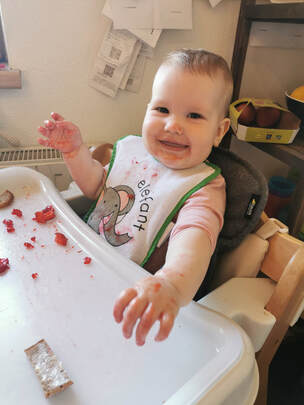
Which, incidentally, she spat out immediately. While she did show some intrigue about the spoon, the food didn’t entice her at all, so we stopped and decided to revisit the matter a little later. In the meantime, however, I realised that she was interested in the food I consumed. She would look at it and grab for it, so I cut it up and gave it to her. She wouldn’t eat it, though. Just suck at it, lick it, mash it, smell it, and so on and so forth.
I was torn. A part of me didn’t want her to play with food – so deeply ingrained was that belief. I wanted to have this picture-perfect image of me putting the spoon to her face and she happily eating it. But she wouldn’t have any of it. She didn’t like being fed, but she enjoyed exploring her food with her hands. And it was a big mess. Her hands, her arms, her tray, the floor underneath – everything was compromised with what she’d eaten, and I worried whether this was the right way to do it. I started doing research and a friend brought me on to BLW – baby-led weaning. I hadn’t heard of it before, but I guess we always need a fancy-schmancy name for something people have done with their babies worldwide for thousands of years (I doubt they had puree glasses in the Middle Ages).
BLW suggests that babies don’t need to eat purees but can immediately share our food – provided it’s not salty, spicy or sugary. I delved into the idea of babies being perfectly capable to deal with chunks of food – even without teeth. While foods like nuts, hard fruit and uncooked vegetables should be avoided due to being a possible choking hazard, babies usually know how to deal with the food.
Armed with my BLW book and the resignation that my baby would never become a “Hipp” baby, I started cutting my food in little chunks and strips for her to eat. Until today she doesn’t really eat a lot of it most days, but she’s eating completely unaided by me, which means I can eat the same time she does. It also means she can eat as much or little as she needs, and eat according to her preferences – which is the main benefit of BLW.
But what about the mess? Have I come to terms with it? How can it be prevented? Is it OK for babies to “play with food”? Well, as with most aspects concerning parenting, I feel the problem lies mostly with the parent not the child. We have unrealistic images of how it “should be”, possibly supported by other mums, our mothers or mothers-in-law. The fact is, life with kids is messy. If you introduce solid foods later, the babies still don’t have the coordination to make it a completely mess-free affair. Maybe you can shift the mess to a few months later if you ladle food into your baby’s mouth with a spoon, but you cannot avoid it, in my opinion.
Also, is it necessary? Babies don’t “play with food”, they explore a new texture, material, taste and smell – just as they do with every other object. Eating a banana is not just putting it in the mouth like for adults, but it is a wholesome experience of the squishy texture, the strong, sweet smell, how it feels when it runs through the fingers, down to how it feels inside the mouth. As a Montessori child, I can only recommend having as many tactile and haptic experiences as possible – even if they mean a bigger mess. The moment I shifted my perspective to this realisation, it was infinitely easier to deal with the mess.
Of course there are days where I worry if I could do things better (like, pretty much every day). What if she becomes a messy eater? What if she never eats from a plate (we put her food on the tray because she just upends the plate and things go everywhere)? When do I introduce cutlery? The “problems” are manifold, but mostly in our heads. With a little trust and a little patience, I am sure Lily will become a good eater who can enjoy not only the taste, but textures, smells and feel inside the mouth.
Even though there are days on which I bemoan the fact that she doesn’t really like the ready meals from the glasses, I am quite glad now that she’s a determined eater, insisting on her independence. Maybe it means we can skip a few steps other mums have to go from their perfect spoon-eating babies to toddlerhood. I guess it all has its pros and cons.

 Mama Bear Tales
Leave a comment